
07
January
2025
How to Measure the ROI of a Website Redesign
Website redesigns can be transformative, but only if you measure their impact effectively. This guide covers both core and advanced metrics and shares bonus tactics like A/B testing, user behavior mapping, and long-term ROI tracking to ensure your redesign drives tangible results.
Introduction:
Redesigning a website goes beyond visuals. It’s a strategic investment that should improve engagement, conversions, brand credibility, and revenue. To determine whether your redesign paid off, you need a rigorous measurement framework grounded in baseline data, continuous tracking, and smart analysis.
Step 1: Set Clear Objectives & Establish Baselines

Before touching any pixel, define your goals:
- Traffic: Increase organic, referral, or paid visits.
- Engagement: Improve bounce rate, session duration, and pages per session.
- Conversions: Aim for more form submissions, e-commerce purchases, or demo requests.
- SEO and Technical Performance: Faster speed, crawlability, and improved rankings.
- Revenue-Driven KPIs: Lower CAC, higher Avg Order Value (AOV), improved Customer Lifetime Value (CLV).
Use Google Analytics, Search Console, and SEMrush/Ahrefs for baseline tr.
Step 2: Track Core ROI Metrics

Monitor these key indicators before and after the redesign:
- Traffic & Engagement
- Organic sessions, CTR, and keyword rankings.
- Bounce rate, session duration, pages per session.
- Conversion Metrics
- Form submissions, newsletter sign-ups.
- E‑commerce indicators: cart add rate, checkout.
- CTA click-through rate and lead quality.
- SEO & Technical
- .Keyword ranking changes, crawl errors, Core Web Vitals.
- Retained backlinks and domain authority after redirects
- UX & Accessibility
- Heatmaps, session recordings for user flow insights.
- Mobile usability, WCAG/ADA compliance.
- Revenue Metrics
- CAC, CLV, incremental revenue from redesign (cosmico.org).
- CAC, CLV, incremental revenue from redesign (cosmico.org).
Step 3: Calculate ROI

Use this formula:
ROI (%) = (Revenue Growth – Redesign Cost) / Redesign Cost × 100
For example: a manufacturing firm saw monthly leads increase from 30 to 66, generating $148.5k extra in first-year revenue against a $50k redesign, with a 197% ROI.
Step 4: Add Advanced Insights
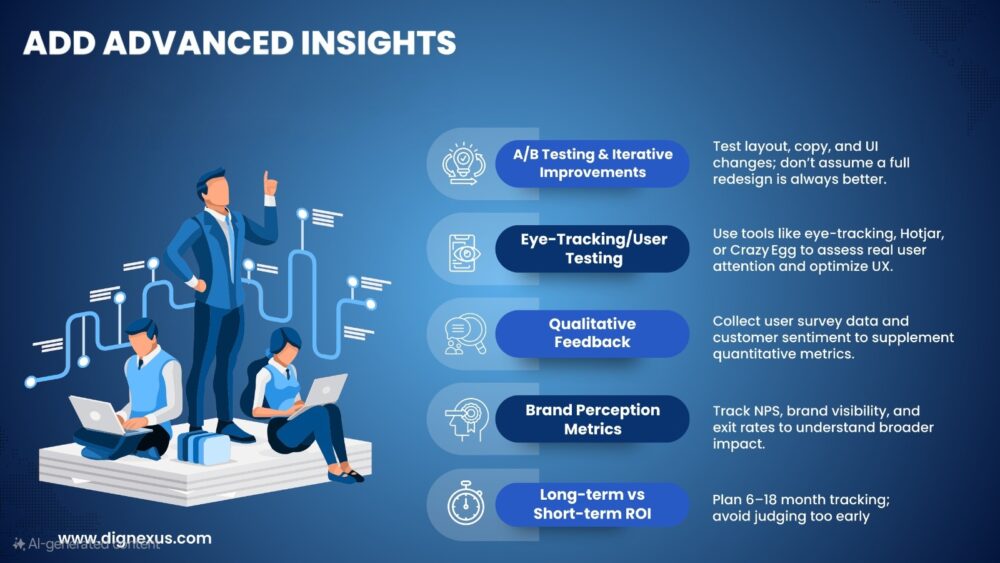
A/B Testing & Iterative Improvements
Test layout, copy, and UI changes; don’t assume a full redesign is always better.
Eye-Tracking/User Testing
Use tools like eye-tracking, Hotjar, or Crazy Egg to assess real user attention and optimize UX.
Qualitative Feedback
Collect user survey data and customer sentiment to supplement quantitative metrics.
Brand Perception Metrics
Track NPS, brand visibility, and exit rates to understand broader impact.
Long-term vs Short-term ROI
Plan 6–18 month tracking; avoid judging too early.
Step 5: Ongoing Maintenance & Growth
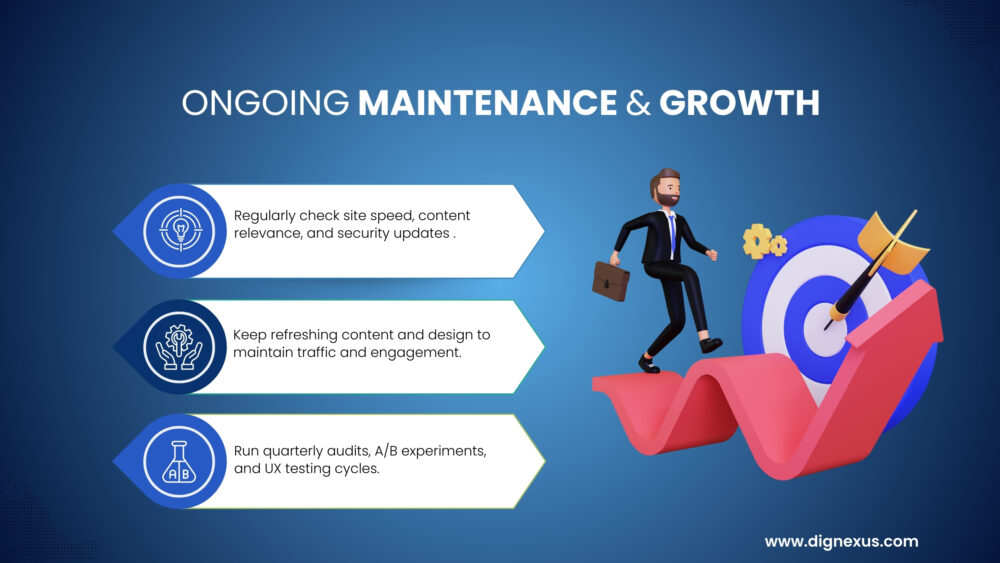
- Regularly check site speed, content relevance, and security updates .
- Keep refreshing content and design to maintain traffic and engagement.
- Run quarterly audits, A/B experiments, and UX testing cycles.
How ROI Varies by Business Type

The return on investment (ROI) from a website redesign isn’t one-size-fits-all. It greatly depends on your business model, industry, target audience, and the role your website plays in customer acquisition. Here’s how ROI can vary:
1. E-commerce Businesses
- ROI Potential: High
- Why: Even small design improvements can lead to big revenue gains. Faster checkout, better mobile UX, and improved product search can significantly boost conversions.
- Key Metrics: Cart abandonment rate, Average Order Value (AOV), revenue per visitor, checkout conversions.
2. SaaS Companies

- ROI Potential: Moderate to High
- Why: Redesigns focused on user onboarding, demo scheduling, or lead nurturing can improve sign-up rates and reduce churn.
- Key Metrics: Sign-ups, CAC, trial-to-paid conversion rate, lifetime value (LTV).
3. Service-Based Businesses (e.g., Law Firms, Agencies)
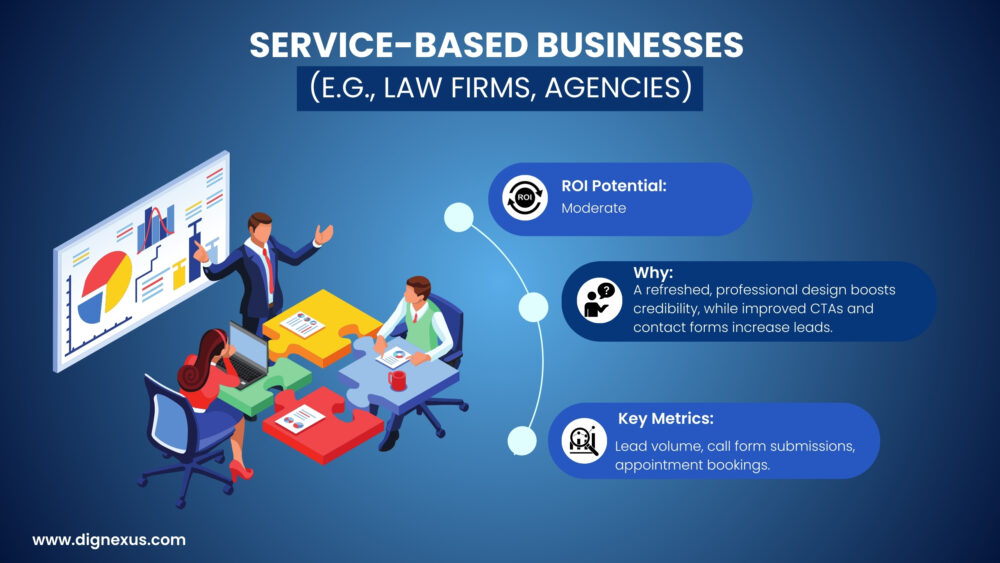
- ROI Potential: Moderate
- Why: A refreshed, professional design boosts credibility, while improved CTAs and contact forms increase leads.
- Key Metrics: Lead volume, call form submissions, appointment bookings.
4. Local Businesses (e.g., Restaurants, Salons, Clinics)
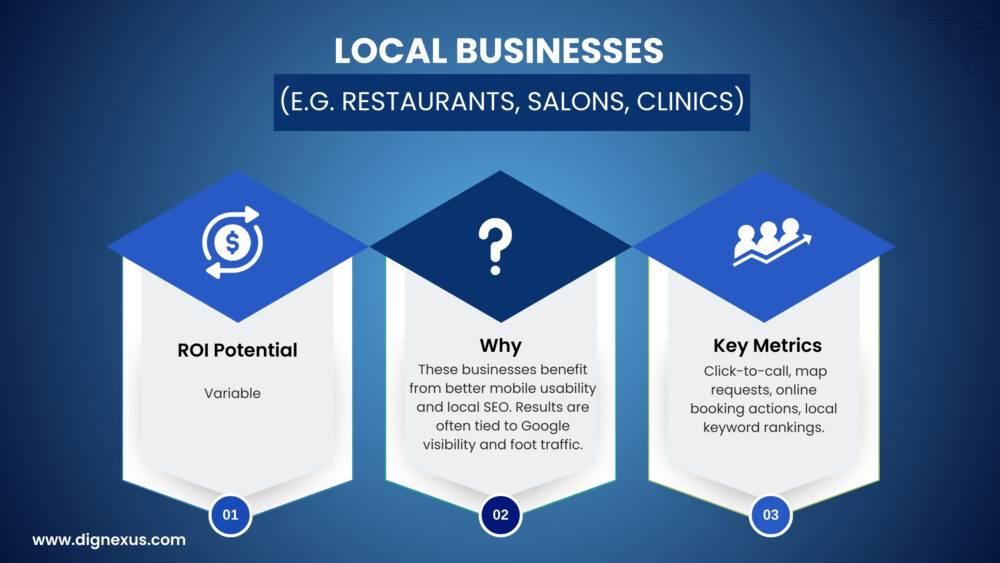
- ROI Potential: Variable
- Why: These businesses benefit from better mobile usability and local SEO. Results are often tied to Google visibility and foot traffic.
- Key Metrics: Click-to-call, map requests, online booking actions, local keyword rankings.
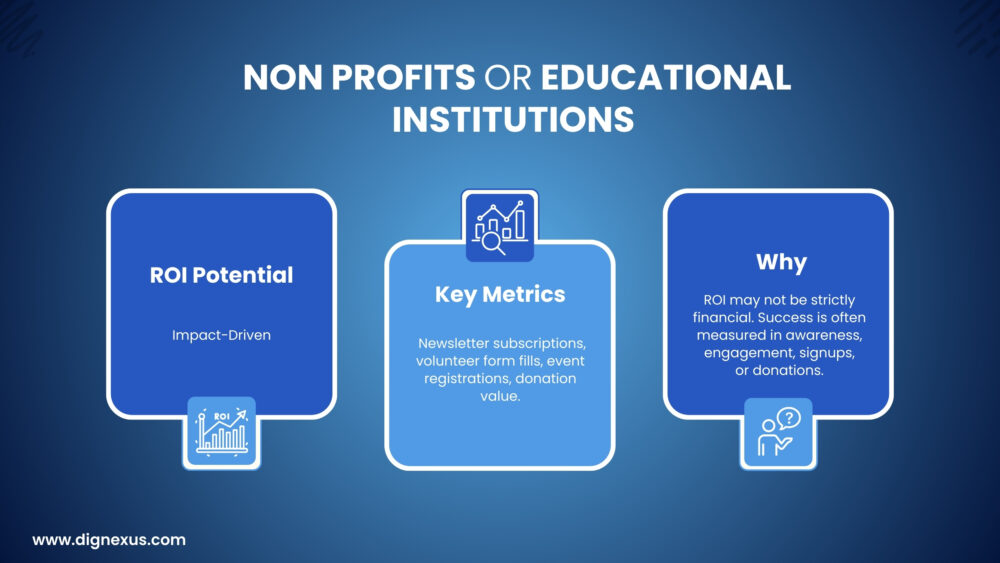
5. Nonprofits or Educational Institutions
- ROI Potential: Impact-Driven
- Why: ROI may not be strictly financial. Success is often measured in awareness, engagement, signups, or donations.
- Key Metrics: Newsletter subscriptions, volunteer form fills, event registrations, donation value.
Quick Metric Checklist
| Metric | Purpose | Tool |
| Organic Traffic | SEO & reach | GA, Search Console |
| Bounce Rate & Time on Site | User engagement | GA, Hotjar |
| Forms/Orders/Add-to-Cart | Conversion effectiveness | GA, Shopify, CRMs |
| Core Web Vitals | Page performance | PageSpeed, Lighthouse |
| Keyword Rankings | Search visibility | SEMrush, Ahrefs |
| Backlink Retention | SEO strength & link equity | Moz, Ahrefs |
| Session Heatmaps | UX improvements | Hotjar, Crazy Egg |
| Mobile & Accessibility | Usability for all users | GA, WAVE |
| CAC, AOV, CLV | Financial returns | CRM, Analytics tools |
| A/B Test Results | Design and copy optimization | Optimizely, VWO |
| Brand Sentiment/NPS | Audience perception | Surveys, social listening |
FAQs
1. How soon can I expect to see ROI after a website redesign?
Most businesses start seeing measurable improvements in 3 to 6 months, but full ROI, especially for SEO, lead generation, or conversion growth, may take 6 to 12 months depending on your goals and industry.
2. What metrics should I track to measure the success of my redesign?
Key metrics include organic traffic, bounce rate, conversion rate, average session duration, and revenue per visitor. You should also monitor technical metrics like page speed, Core Web Vitals, and mobile usability.
3. Can a website redesign hurt my SEO performance?
Yes, if done incorrectly. Issues like broken redirects, missing metadata, or content changes can cause a temporary drop in rankings. However, a properly executed redesign with SEO best practices in mind can actually improve performance over time.
4. How do I know if the redesign is improving conversions?
Use tools like Google Analytics, Hotjar, or A/B testing platforms to compare pre- and post-redesign conversion data. Look at actions like form fills, purchases, call clicks, or demo signups to measure impact.
5. Is a redesign worth the cost for small or local businesses?
Absolutely, especially if your current website is outdated, slow, or not mobile-friendly. A well-designed, SEO-optimized site can dramatically improve your local search visibility, build trust with customers, and generate more qualified leads.
Final Takeaway
A successful website redesign is an ongoing strategy, not a one-time event. By combining
- Clear objectives and baselines
- Robust metric tracking (traffic, conversion, UX)
- Continuous testing and user feedback
- Long-term ROI evaluation
You ensure your redesign not only looks great but also fuels growth and boosts profitability. Empower your digital strategy with data-driven insights.
At Dignexus, we don’t just redesign websites; we rebuild your digital strategy for performance, conversions, and measurable growth. Whether you’re an eCommerce brand, a service provider, or an enterprise business, our team blends creativity with data-driven execution to ensure every pixel delivers value.
🎯 Let’s turn your redesign into real results.
👉 Contact us today for a free consultation and ROI roadmap tailored to your business.
POST SLIDER



We are experienced professionals who understand that It services is changing, and are true partners who care about your future business success.
Our Location
- Maclean House, 4th Floor, 4E, EN 13, Salt Lake, Sector V, 700096 ( Near Webel More)
Quick Contact
- Email: [email protected]
- Support: +91 99031 11057
Opening Hours
- Monday - Saturday
- 10:00 am to 7:00 pm