14
February
2026
MVP Development Guide for Startups
Building a startup in 2026 feels nothing like it did even a couple of years ago. The old “launch it and see what happens” mindset doesn’t hold up anymore. Attention is harder to earn, competition is louder, and people won’t stick around for a product that doesn’t quickly and clearly solve something real for them.
Whether you’re working with a Mobile App Development Company or building in-house, your MVP strategy determines whether your startup scales or stalls.
If you’re a founder planning to build a Minimum Viable Product (MVP), focus less on adding features and more on what you need to learn. This guide walks you through a practical, modern roadmap for MVP development, including the key validation stages and the common mistakes that derail many early-stage ventures.
The Core Shift: From Feature-Heavy to Data-Driven
In 2026, launching an MVP isn’t the finish line — it’s the starting point. The real purpose is to gather meaningful, first-hand insights into how people actually use your product — insights that no competitor can replicate or access.
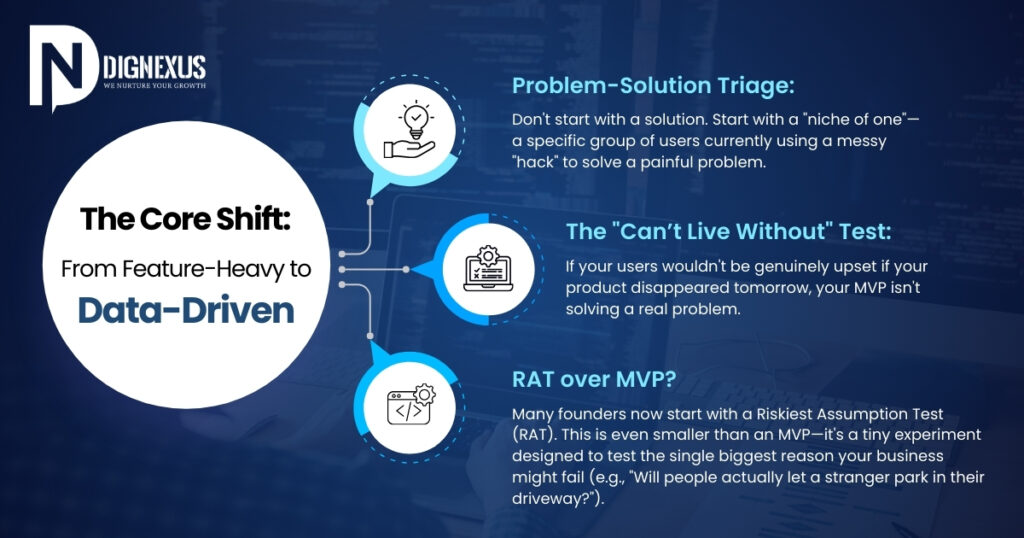
- Problem-Solution Triage: Don’t begin by building a solution. Begin by identifying one very specific type of user — someone who’s already piecing together a messy workaround to deal with a frustrating, real problem.
- The “Can’t Live Without” Test: The brutal truth? If nobody would be upset losing your product tomorrow, you’re building something people don’t actually need.
- RAT over MVP? A lot of founders now start with a ‘Riskiest Assumption Test’ (RAT). It’s smaller than an MVP—just a quick experiment to test your biggest risk. Like: will people actually let strangers park in their driveway?
Defining Your “Minimum” (The 80/20 Rule)
A lot of founders confuse MVPs with their first polished product. Here’s the reality: if shipping your MVP doesn’t make you uncomfortable, it’s not minimal enough.
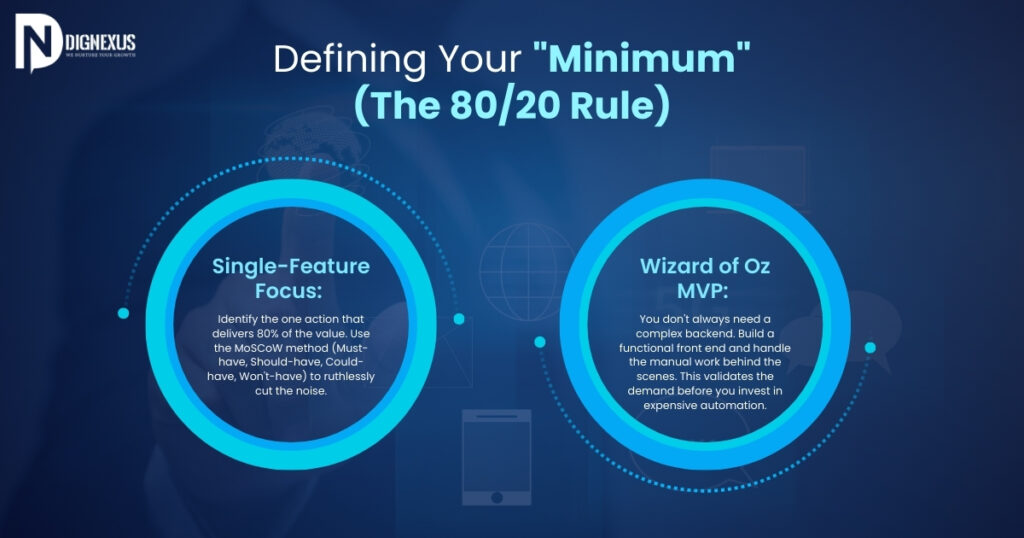
- Single-Feature Focus: Figure out the one thing that delivers most of the value—usually it’s about 80%. Then ruthlessly cut everything else. The MoSCoW method helps: Must-have, Should-have, Could-have, and Won’t-have.
- Wizard of Oz MVP: Skip the complex backend for now. Build a working front end and just do the backend work by hand. That way you’ll know if people actually want this thing before you sink money into automating it.
Choosing the Right Tech Stack for Speed
Speed is the only real edge you have. Pick your tech stack in 2026 based on what gets you to something valuable the quickest.
| Category | Recommended 2026 Tech | Why? |
| Frontend | Next.js / Flutter | Fast, SEO-friendly, and cross-platform. |
| Backend | Node.js / Python | Scalable and perfect for AI integrations. |
| No-Code | Bubble / WeWeb | Best for validating simple SaaS ideas in weeks. |
| AI Layer | OpenAI / Anthropic API | Don’t build LLMs; leverage existing ones. |
The 12-Week Validation Roadmap
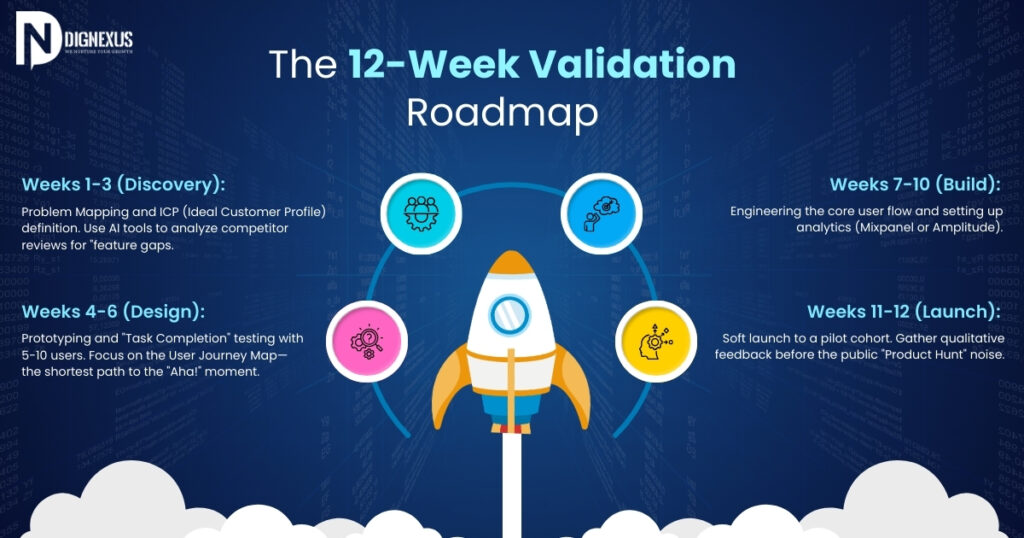
Don’t let yourself get trapped in endless development. Use this timeline to stay lean:
- Weeks 1-3 (Discovery): Map out the problem and nail down your ICP (ideal customer profile). AI tools are great for analysing competitor reviews to find the features people wish existed.
- Weeks 4-6 (Design): Prototyping and “Task Completion” testing with 5-10 users. Focus on the User Journey Map—the shortest path to the “WOW” moment.
- Weeks 7-10 (Build): Build out the main user flow and get your analytics set up—something like Mixpanel or Amplitude.
- Weeks 11-12 (Launch): Launch quietly with a small group first. Get real feedback from actual users before you deal with all the Product Hunt chaos.
Avoiding the “MVP Graveyard”
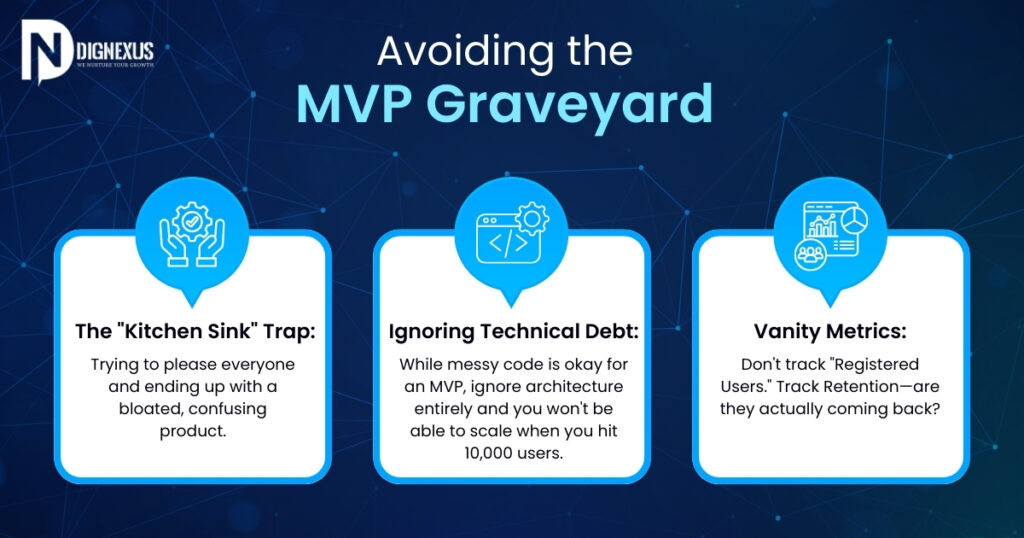
Here’s the thing about MVPs—they usually don’t fail because of bugs or bad code. They fail because of strategy mistakes:
- The “Kitchen Sink” Trap: You attempt to satisfy everyone and wind up building something bloated and confusing.
- Ignoring Technical Debt: Messy code is totally okay in an MVP, but don’t skip architecture altogether. When you suddenly have 10,000 users, you’ll regret it if you can’t scale.
- Vanity Metrics: Stop obsessing over how many users you have. Focus on retention instead—are they actually using it more than once?
FAQ:
Q: How much does it cost to build an MVP in 2026?
A: While a simple no-code MVP can cost under $10,000, a standard SaaS MVP typically ranges from $30,000 to $60,000. AI-powered MVPs often start higher due to API and infrastructure costs.
Q: What is the difference between an MVP, a Prototype, and a PoC?
A: Here you go.
- PoC (Proof of Concept): Verifies if the tech is even possible.
- Prototype: A non-functional “look and feel” model for feedback.
- MVP: A functional product released to real users to gather data.
Q: What comes after the MVP?
A: Once you have validated the core loop, you move toward a Minimum Marketable Product (MMP). This involves polishing the UI, fixing bugs found during the MVP phase, and introducing your first revenue models.
Q: How do I know if my MVP is successful?
A: Look at your Activation Rate and 30-Day Retention. If 40% of users are still active after a month without you prompting them, you’re on the right track toward Product-Market Fit (PMF).
Q: Should I use No-Code or Custom Code?
A: Use No-Code if you need to validate a workflow or data management tool quickly. Choose custom code if your product requires complex algorithms, real-time data processing, or unique hardware integrations.
Q: How do I handle negative feedback during the MVP phase?
A: Negative feedback is actually more valuable than “it’s okay.” If a user is complaining, they care enough about the problem to be frustrated by your solution. Categories feedback into “UI/UX friction” (easy fix) versus “Value Gap” (the product doesn’t solve the core problem). If it’s a Value Gap, you may need to pivot.
Q: Is it better to build a Web App or a Mobile App for an MVP?
A: Unless your core value depends on mobile-specific hardware (like GPS, Camera, or Push Notifications), start with a Web App. Web apps are easier to update instantly, better for SEO, and don’t require waiting for App Store approvals during the rapid iteration phase.
Q: When should I stop iterating on the MVP and move to V1?
A: Move to V1 when you hit the “Rule of 40”: when 40% of your surveyed users say they would be “very disappointed” if they could no longer use your product. At this point, you aren’t just testing a hypothesis anymore; you’re fulfilling a market demand.
Q: How do I protect my MVP idea from being copied by big competitors?
A: The hard truth: You can’t protect an idea, only the execution and the community. Big companies rarely move fast enough to copy an MVP. Your advantage is your direct relationship with early adopters and your speed of iteration. Don’t let “stealth mode” prevent you from getting the feedback you need to survive.
Q: Why should I hire a Mobile App Development Company instead of freelancers?
A: A professional Mobile App Development Service provider offers structured validation processes, scalable architecture planning, and post-launch support. Unlike freelance-only setups, agencies bring cross-functional expertise in UX, backend systems, DevOps, and growth analytics, reducing long-term technical debt.
POST SLIDER


We are experienced professionals who understand that It services is changing, and are true partners who care about your future business success.
Our Location
- Maclean House, 4th Floor, 4E, EN 13, Salt Lake, Sector V, 700096 ( Near Webel More)
Quick Contact
- Email: [email protected]
- Support: +91 99031 11057
Opening Hours
- Monday - Saturday
- 10:00 am to 7:00 pm